When the Past Won’t Let Your Mind or Body Rest
Held Hostage by Your Own Survival System
PTSD doesn’t live in the past — it hijacks your present and steals your future:
- Your body stays on high alert — exhausted from constant vigilance, jumping at shadows, unable to distinguish between memory and reality
- Triggers are everywhere — a smell, a sound, a date on the calendar can instantly transport you back to the worst moment of your life
- Safety feels impossible — even in secure environments, your nervous system insists danger is imminent, keeping you ready for threats that aren’t coming
- Relationships suffer from invisible wounds — pulling away from touch, unable to trust, watching loved ones struggle to reach you through the protective walls
This isn’t weakness or “not being over it.” Your brain is stuck in survival mode, replaying old programming because it doesn’t know the danger has passed.

Your Nervous System Needs More Than Time to Heal
After 35 years working with trauma survivors, I’ve learned that the bravest people often struggle the most — not because they lack courage, but because their brains are still protecting them from dangers that no longer exist.
- Expertise with complex trauma and PTSD — from childhood trauma to combat veterans to accident survivors
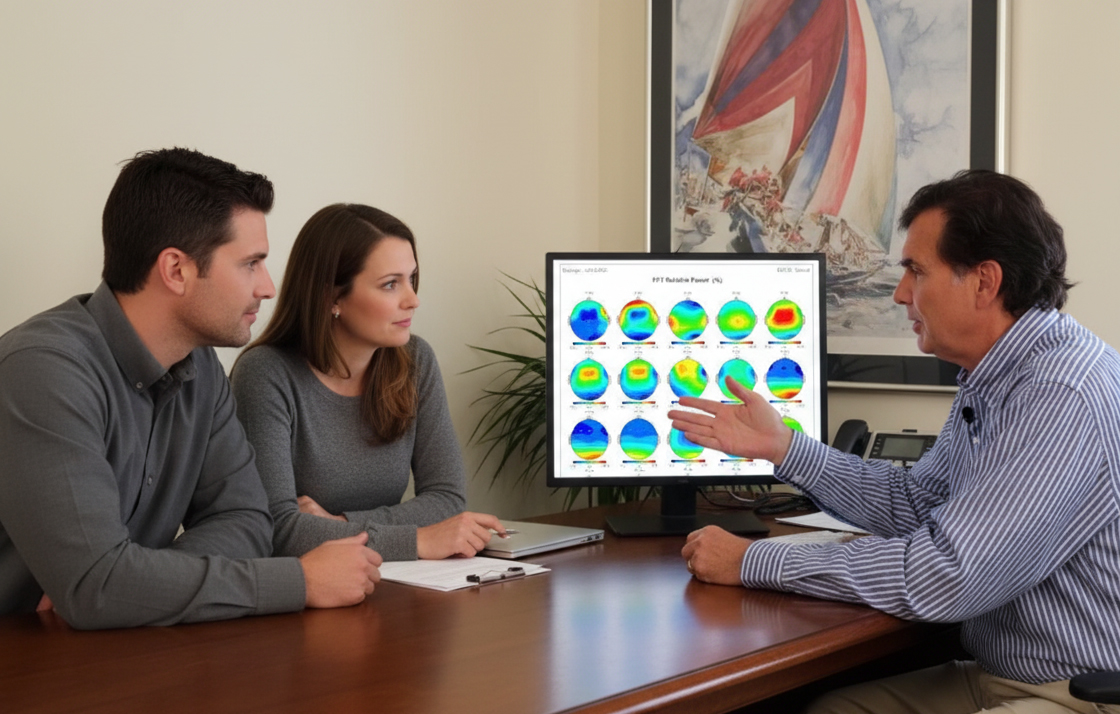
- QEEG mapping that shows trauma’s signature — seeing the hypervigilance and dysregulation keeping you stuck
- Success without retraumatization — no reliving events, no exposure therapy, just gentle brain training
- True resolution — not managing triggers forever but actually feeling safe again
“When survivors see their brain map showing the stuck survival patterns, everything makes sense: ‘My brain doesn’t know I survived.'” — Dr. Randy Cale
Teaching Your Brain the Danger Is Over
We map the trauma patterns.
Your QEEG reveals hyperactivity in the limbic system (fear center), disrupted communication between regions that distinguish past from present, and a nervous system stuck in emergency mode. Your brain literally can’t tell the difference between then and now.
We train toward safety
Through neurofeedback, your brain practices calm, regulated states. When your nervous system achieves even brief moments of genuine rest, it receives encouragement. Session by session, your brain learns what it feels like to not be under threat..
Safety becomes real, not just logical.
Your body starts believing what your mind knows — the danger passed, you survived, and it’s safe to rest. Not through forcing relaxation or positive thinking, but through your nervous system actually recognizing safety at the deepest level.
From Surviving to Feeling Safe
Most trauma survivors notice their nervous system beginning to settle within 4-8 weeks. Triggers lose intensity. Sleep becomes restorative instead of vigilant. The past stays in the past. Your brain finally understands at every level: you made it through, and now you can rest.
Real Stories: From Perpetual Danger to Genuine Safety
The Woman Who Finally Closed the Door on Trauma
Leslie, 34
Leslie’s childhood trauma had her nervous system on constant alert for decades. Twenty years of therapy helped her understand but not heal. Multiple panic attacks daily. Unable to feel safe even in her own home.
“I was in fight or flight every day. Multiple times a day. I was constantly still living in my trauma.”
Her brain map showed classic PTSD patterns — hyperactive fear centers, inability to distinguish past from present. Through neurofeedback, her nervous system learned safety for the first time since childhood.
“The door is closed on the trauma. I’m moving forward. For the first time, the future doesn’t look scary.”
Today Leslie experiences what she calls “a miracle” — comfort in her own body, the ability to be touched without fear, and genuine excitement about tomorrow.

What Life Feels Like After Your Nervous System Finds Peace
Imagine your body finally believing you’re safe:
- Sleep without vigilance — deep, restorative rest instead of one eye open
- Present-moment living — experiencing now instead of reliving then
- Triggers lose their power — reminders become just memories, not time machines
- Physical comfort returns — your body relaxes, tension releases, touch feels safe
- Trust becomes possible — in yourself, in others, in the fact that you survived
- Joy without guilt — permission to be happy without waiting for disaster
“For the first time since it happened, I feel safe in my own body. The trauma is a memory now, not something I’m still living through.” — Combat Veteran, 34
Trauma Rewires the Brain — Neurofeedback Rewires It Back
PTSD creates identifiable patterns in the brain — areas meant for current awareness get hijacked by past threats. The amygdala fires constantly, the hippocampus can’t properly file memories, and the prefrontal cortex goes offline when you need it most. Your brain is doing exactly what it evolved to do: protect you from danger. It just hasn’t realized the danger ended.
Evidence-Based. Drug-Free. Restorative.
Research confirms neurofeedback resolves PTSD by calming hyperactive fear centers and restoring the brain’s ability to distinguish past from present.
Why it succeeds where talking fails:
- No retraumatization — heals without reliving or exposure therapy
- Addresses the nervous system — where trauma actually lives, not just thoughts
- Builds genuine safety — your brain learns you survived, not just your mind
- Creates lasting peace— not coping with triggers but eliminating the triggered state
When your brain finally learns the war is over, you stop fighting battles that ended years ago.
The Choice Point
Your nervous system can stay frozen in survival or learn to recognize safety. The choice starts now..
The Journey From Hypervigilance to Peace
As you begin neurofeedback for PTSD:
- Moments of unexpected calm — brief windows where your body isn’t braced for impact
- Triggers start losing intensity — still there but less overwhelming, less transporting
- Sleep gradually deepens — from vigilant rest to actual restoration
- The past finds its proper place — as history, not current event
“I spent 20 years in therapy talking about my trauma. But my body never got the message that I was safe until neurofeedback.” — Leslie, 34
The Cost of Staying Stuck in Survival Mode
Without retraining your nervous system:
- Hypervigilance becomes your permanent state — exhausting your body and mind
- Triggers multiply over time — more reminders, more avoidance, smaller world
- Health deteriorates — chronic stress destroys immune function, heart health, digestion
- Relationships reach breaking points — people can’t reach you through the armor
Every day in survival mode when you’re actually safe is a day stolen by trauma. Your nervous system needs to learn the truth: you survived, it’s over, and you’re allowed to rest.
Your Next Step: Tell Your Nervous System the Torture Is Over
You’ve tried talking through it, processing it, understanding it. Maybe you’ve tried medications to numb it or exposure therapy to face it. But your body still acts like you’re in danger because trauma lives in your nervous system, not your thoughts.
Let’s map your brain and teach it what safety actually feels like.