About Dr. Randy Cale and Capital District Neurofeedback
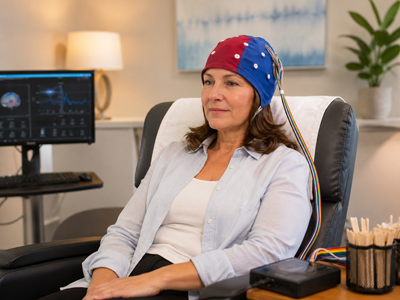
I’m Dr. Randy Cale, a licensed psychologist and the owner and clinical director of Capital District Neurofeedback. Our work is focused on helping children, teens, and adults improve how their brains regulate attention, anxiety, mood, sleep, emotional control, and cognitive performance.
We use qEEG brain mapping to guide neurofeedback training and, when appropriate, integrate other brain-based technologies such as heart-rate variability training, PEMF, and photobiomodulation. While the technology is sophisticated, the philosophy behind our work is refreshingly simple:
We Measure Before We Try to Change
A diagnosis can be helpful. It gives a name to a recognizable collection of symptoms. But a diagnosis does not tell us precisely how one person’s brain is functioning, where dysregulation may be occurring, or what type of training that particular brain may need.
Two people can share the same diagnosis and still have remarkably different patterns of brain activity. One child with ADHD may be significantly underaroused, while another may struggle primarily with excessive activation, anxiety, or poor communication between important brain regions. Training both brains in precisely the same way would make little sense.
Diagnoses don’t learn. Brains do.
That is why we begin with a careful review of symptoms, history, prior treatments, medications, sleep, stress, and daily functioning. We then complete a qEEG brain map to measure patterns of electrical activity throughout the brain. The map does not replace clinical judgment, and it does not provide another psychiatric diagnosis. It gives us objective information that helps us understand what may be happening beneath the symptoms.
Only then do we develop an individualized neurofeedback training plan.
Neurofeedback Designed Around the Individual
Neurofeedback gives the brain immediate information about its own activity. Over time, the brain learns to produce healthier and more efficient patterns. This learning takes place naturally, much as the brain learns any other skill through repetition, feedback, and practice.
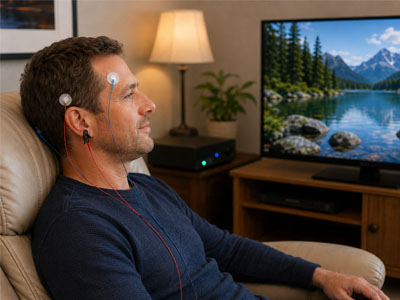
Training may be completed in our Clifton Park office or, when clinically appropriate, through one of our supervised home-training programs. Home training allows many clients to train more frequently and conveniently without losing the clinical guidance that makes the process meaningful. We monitor progress, evaluate real-world changes, adjust protocols when needed, and repeat brain mapping when appropriate.
We may also integrate additional technologies and practical interventions to support the training process. Sleep, breathing, stress, nutrition, activity level, trauma, relationships, and daily habits all influence how the brain functions. We do not ignore those factors simply because we have sophisticated equipment in the room. The goal is not merely to produce a more attractive brain map. The goal is to help someone sleep better, think more clearly, feel calmer, focus more consistently, and move through life with greater ease.
About Dr. Randy Cale
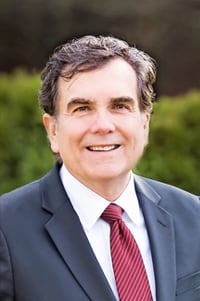
I later devoted much of my career to working with children, parents, and families. As a parenting expert, author, speaker, and creator of TerrificParenting.com, I spent years helping parents understand behavior and create healthier, more effective family patterns. I have written extensively about parenting, personal growth, emotional development, and the practical science of lasting change.
Yet over time, one reality became impossible to ignore: good therapy, effective parenting strategies, medication, insight, and determination were sometimes not enough. Adults and children often knew exactly what they wanted to change but remained unable to make that change consistently. The missing piece was not always motivation or effort. Sometimes the brain itself remained stuck in a dysregulated pattern.
That realization led me deeply into qEEG brain mapping, neurofeedback, and other brain-based technologies. Today, these approaches are the primary focus of my clinical work.
At Capital District Neurofeedback, we combine decades of psychological experience with objective measurement, individualized brain training, and thoughtful clinical support. We do not promise that one approach works for everyone. We do promise to look carefully, measure what we can with advanced EEG technology, listen closely to you/your family’s concerns and struggles, and then develop a plan based on the individual—not simply the label or a group of symptoms.
Remember: We must measure the brain… before we try to change the brain.
Because when we better understand the brain, we have a much better chance of helping it shift toward health, ease and better functioning.