Trapped by the Next Attack: The Silent Fear That Rules Your Life
No warning. No control. Just the constant, exhausting fear: “When will it happen again? What if it happens while I’m driving? What if everyone sees me losing it?” The attacks themselves are terrifying. But it’s the anticipation— the hypervigilance, the avoidance, the shame—that truly imprisons you.
How Neurofeedback Helps Panic & Anxiety Attacks
Loading Image...
A Different Way to Stop Panic at the Source
Most people who come here have already tried a lot—therapy, medication, books—often leaning on others for support. Sometimes it helps. You’re likely here because the panic still returns.
Living in Constant Preparation
When the Attacks Start Running Your Life
At first, it’s about the attacks. But over time, it becomes about everything you do to avoid them. Even when they’re not happening, they’re still there—quietly shaping your decisions and limiting how you live.
Whether you’ve been told it’s panic attacks, anxiety attacks, or both, the experience is the same: your body goes into a full alarm response when it doesn’t need to. You start planning your life around it—where you sit, how quickly you can leave, who you’re with, what might happen if it starts again.
There’s a constant scanning in the background… Am I okay? Is this building? What if it hits right now? Should I go or should I stay? Your body begins to feel less predictable, less trustworthy—like it could turn on at any moment—and you’re always trying to stay one step ahead.
And over time, this changes how you live. You begin avoiding certain places and situations—sometimes entire parts of your life. And your world becomes smaller because of it—And you know—this isn’t who you are, and it’s not the life you want.
Why This Keeps Happening
Panic isn’t a lack of control. It’s a brain that’s learned to trigger a full alarm response too quickly—and too often.
Once that pattern is learned, it runs automatically—even when there’s no real danger. You can understand it. You can prepare for it. You can try to manage it with CBT, meds, or coping strategies.
But if your brain keeps firing that same alarm response… it keeps coming back. Which is why, for many people, it never fully goes away.
Why This Approach Is Different
After 30 years working with panic, one pattern shows up again and again: the issue isn’t that people don’t know what to do—it’s that their brain shifts into an alarm state too quickly, and once it does, thinking and coping tools become very difficult to access in that moment.
That’s why so many well-intended approaches fall short. Breathing techniques, grounding, and cognitive strategies can be helpful—but they depend on the brain being stable enough to use them. When the alarm system is already activated, those tools often don’t “reach” the part of the brain that’s driving the panic.
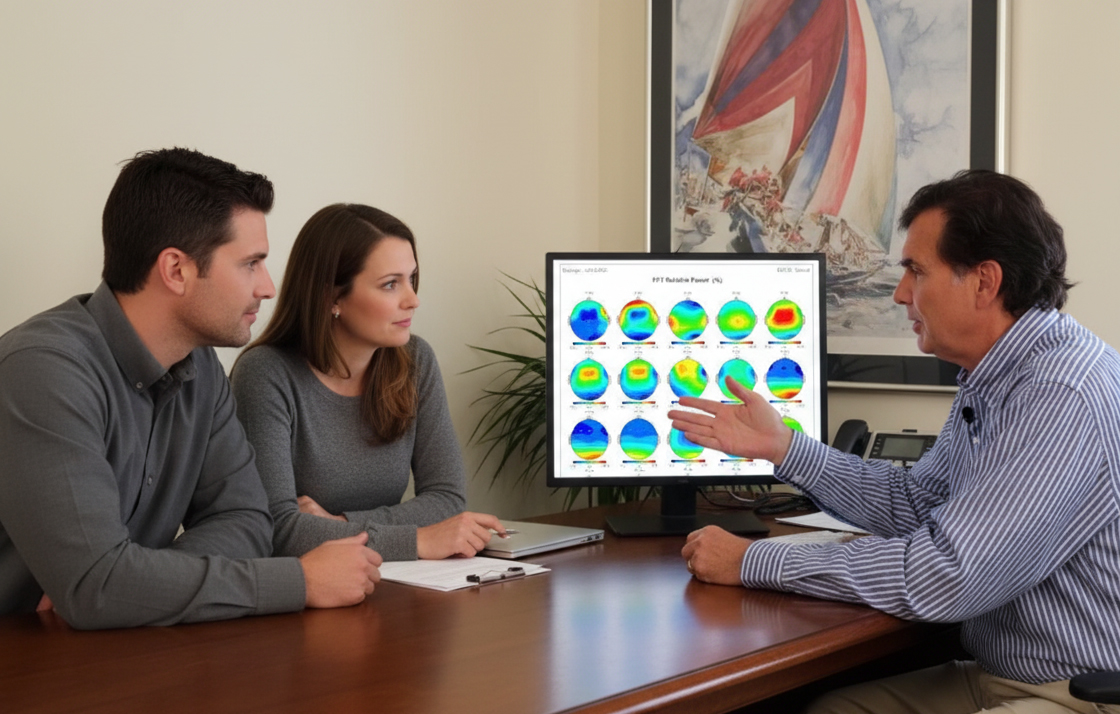
This approach works at a different level. Through brain mapping, we can see how your brain is functioning during these patterns—where it’s over-activating, under-regulating, or getting stuck. From there, neurofeedback training is used to help the brain gradually shift out of that reflexive alarm response and into a more stable, regulated state.
As that happens, something very practical changes: the alarm doesn’t trigger as easily, and when it does, it doesn’t escalate in the same way. That’s when people begin to notice that the strategies they’ve already learned finally start to work—and over time, the panic stops showing up the way it used to.
We’ll take a look at what’s driving your panic—and whether this approach is a good fit for you.
How This Actually Works (The Basics)
1. Map — See What’s Actually Driving the Panic
We begin with brain mapping to understand how your brain is functioning—not in theory, but in your case.
This allows us to identify the specific patterns behind the panic response—where the brain is over-activating, getting stuck, or misfiring.
For many people, this is the first time things actually make sense.
2. Train — Retrain the Brain’s Alarm Response
From there, we begin training the brain to shift out of that reflexive alarm state, using Neurofeedback.
This isn’t something you have to force or think your way through. The brain gradually learns a more stable, regulated pattern.
Over time, the alarm doesn’t trigger as easily—and when it does, it doesn’t escalate the same way.
No pain. No pressure. Just gentle, natural change.
3. Live — A Different Experience of Your Life
As that pattern changes, your experience begins to change with it.
You’re no longer planning your life around panic. You’re no longer constantly scanning or bracing for what might happen.
And something people notice again and again:
They feel like themselves again.
From Surviving to Living
Many clients begin to notice meaningful changes within weeks—more ease, less thinking about the panic – and for many, panic episodes stop occurring altogether over time.
Schedule a Free Consultation
Speak directly with Dr. Cale
What This Looks Like in Real Life
“I started avoiding things because I never knew when it would hit. After a few weeks of training, something changed. The panic didn’t build the same way—and then it just stopped showing up like it used to. I can go places again without thinking about it…I have my life back.”
“I could be fine one minute, and then my body would just flip. What changed for me wasn’t just fewer attacks—it was that my body stopped reacting like everything was an emergency. That alone changed everything.”
“I didn’t realize how much I was avoiding until I didn’t have to anymore. I’m doing things now that I hadn’t done in years—without thinking about where the exits are.”
Schedule Free Consult with Dr. Cale
We’ll take a look at what’s driving your panic—and whether this approach is a good fit for you.
Remember Who You Were Before Fear Moved In?
That person still exists. Here’s what they’re doing now:
- Booking travel without dread — vacation planning is exciting again, not terrifying
- Sitting in traffic peacefully — bridges and tunnels are just infrastructure, not trapped spaces
- Feeling emotions without fear — excitement doesn’t get misread as panic
- Working out hard — your heart can race from exercise without triggering alarm
- Living spontaneously — yes to dinner invitations, concerts, last-minute adventures
- Trusting tomorrow — going to bed knowing you’ll wake up okay
“Six months ago, I couldn’t leave my neighborhood. Yesterday I flew across the country. Alone. And enjoyed it.” — Marcus, 38
The Neuroscience Behind Your Panic
QEEG brain mapping reveals the dysregulation driving panic attacks. Multiple brain regions show irregular patterns — overactive fear centers, underactive calming mechanisms, and poor communication between systems that should work together.
These patterns developed over time as your brain learned to treat normal situations as emergencies. But what the brain has learned, it can relearn. Through neurofeedback training, your brain practices healthier patterns until they become automatic.
The result: your nervous system stops creating panic attacks. Not because you’ve learned to manage them better, but because the neurological conditions that created them no longer exist.
One Brain. Many Symptoms. How Neurofeedback Helps With Conditions.
Evidence-Based. Drug-Free. Lasting.
Dozens of research studies confirm that neurofeedback helps reduce obsessive thoughts and compulsive behaviors by improving self-regulation and brain flexibility.
Why it works where other treatments fail:
- Addresses the source — fixes misfiring alarm systems, not just symptoms
- No side effects — unlike medications that create dependence or withdrawal
- Builds resilience — each session strengthens your nervous system’s stability
- Creates autonomy — no lifelong management or coping strategies needed
When your nervous system relearns the difference between real and false danger, panic loses its power to control your life.
Train Calm — or Strengthen Fear. The Choice Is Yours.
Neurofeedback helps your brain unlearn panic’s false alarms before they tighten their grip. Start now, while calm is still easier to reclaim.
You Can Get Your Life Back
With Neurofeedback:
- Relief often begins within 2-3 weeks — the first time you feel a sensation without spiraling into panic, you know something’s changing
- Each session builds confidence — your brain learns to stay calm in situations that used to trigger attacks
- Your comfort zone expands naturally — places you’ve avoided for years become accessible again
- You reclaim lost years — imagine the next decade lived fully, not spent managing fear
“I wish I’d found this before I spent 10 years afraid to leave my house. But I’m grateful I found it — I have my whole life ahead of me now.” — Robert, started neurofeedback at 43
But Every Panic Attack Makes the Next One More Likely
Without Neurofeedback:
- The fear network strengthens — each panic attack reinforces your brain’s faulty alarm system
- Avoidance grows — first highways, then stores, then anywhere you’ve panicked before
- Medication dependency deepens — benzos for emergencies become daily necessities
- Your life gets smaller — until panic disorder becomes panic prison
The good news? Even severe panic disorder can be retrained. The key is starting before more of life gets stolen.
Your Next Step: Silence the False Alarms. Reclaim Your Life.
You don’t have to live at the mercy of random panic attacks or spend your life avoiding triggers. Real change starts with understanding what’s happening in your brain — and training it to stop sounding false alarms.
Take the first step today. Your body can be a safe place to live again.
Schedule Free Consult with Dr. Cale
We’ll take a look at what’s driving your panic—and whether this approach is a good fit for you.
When Nothing Else Works Why Neurofeedback
Learn how neurofeedback can help you or your loved ones. Download Dr. Cale’s eBook that explains how neurofeedback operates in easy-to-understand terms. Individuals of all ages share their stories about the benefits of working with Dr. Cale, and how seeking treatment has made a difference in their child’s and their own lives!
Looking for your best solution? Click Here